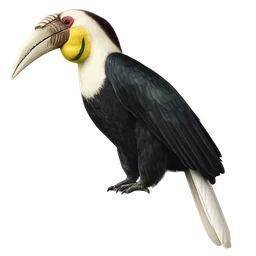
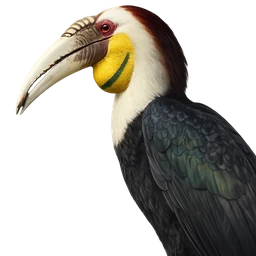
Profile
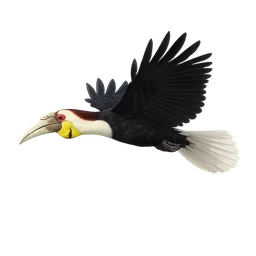
In flight
Hornbills
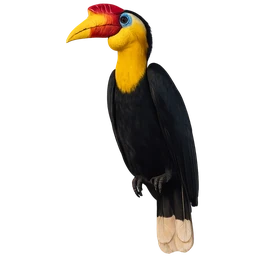
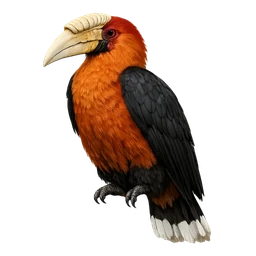
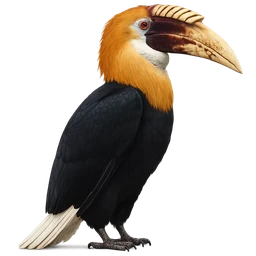
Wreathed Hornbill
Rhyticeros undulatus
- epic
- 49 km/h
- Vulnerable
Follows fig trees across SE Asia in noisy flocks. Male carries a yellow throat pouch striped black. Excellent timing.
- Population
- No precise global population figure published by BirdLife/IUCN; described as locally common in parts of its wide range but overall decreasing, with a suspected 30-49% reduction projected over three generations (~57 years), driven by deforestation (32.8% loss in range 2000-2012) and hunting
- Habitat
- Extensive primary evergreen/tropical rainforest, mainly lowland and hill forest but tolerating some montane and selectively logged habitat with adequate fruiting trees; occurs from lowlands up to ~2,560 m elevation (seasonal altitudinal movement to higher ground outside breeding); strongly forest-dependent and avoids heavily disturbed/open areas
- Fun fact
- During breeding, the female Wreathed Hornbill seals herself inside a tree-cavity nest with mud and droppings, remaining walled in with her chick for roughly 111-137 days (with a ~40-day incubation) while the male delivers fruit and insects through a narrow slit.
- Range
- Southeast Asia: southern Bhutan, Bangladesh, and northeastern India (Assam, Arunachal Pradesh) east through Myanmar, Thailand, Laos, Cambodia, and Vietnam, south through Peninsular Malaysia and Brunei to the Indonesian islands of Sumatra, Java, Bali, and Borneo plus a few smaller islands
- Diet
- Primarily frugivorous — figs and other lipid-rich drupes/fruits (reportedly 30+ tree genera) make up the bulk of the diet, swallowed whole via "ballistic food transport"; supplements with insects, small reptiles, crabs, snails, and occasionally small birds, especially during breeding
- Size
- 0.85 m
- Wingspan
- 1.5 m
- Lifespan
- 30 years