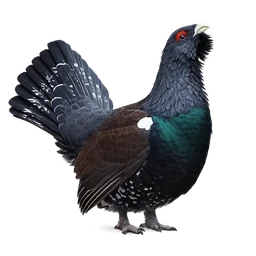
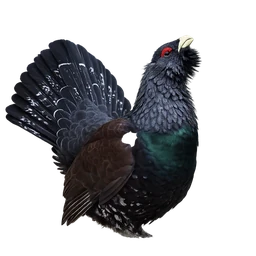
Profile
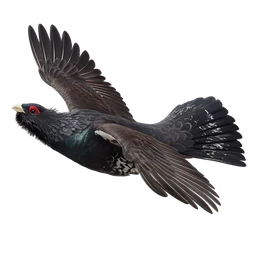
In flight
Game Birds
Western Capercaillie
Tetrao urogallus
- epic
- 44 km/h
- Least Concern
Europe's largest grouse. Males go deaf during their own display call. Your message may need to wait.
- Population
- 3,980,000–8,550,000 mature individuals globally (declining trend)
- Habitat
- Extensive old-growth, shady conifer/mixed boreal and temperate forest with open canopy, damp soil, bogs, and dense ericaceous (e.g. Vaccinium/bilberry) ground cover; typically 0–2,000 m elevation
- Fun fact
- The western capercaillie is one of the most sexually dimorphic bird species alive, with males roughly twice the mass of females, and males perform an elaborate, distinctive courtship display and vocalization at traditional communal breeding grounds called leks.
- Range
- Widespread across the Palearctic from Scandinavia and Scotland (reintroduced; native range once included Ireland, now extinct there) through the Alps and continental Europe to Siberia and Mongolia; present in ~39 countries, extent of occurrence ~21.7 million km²
- Diet
- Herbivorous/omnivorous: buds, leaves, berries, grasses, and shoots, switching to almost exclusively conifer (pine/spruce) needles in winter; chicks rely heavily on insects for protein in their first weeks
- Size
- 0.85 m
- Wingspan
- 1.08 m
- Lifespan
- 7 years