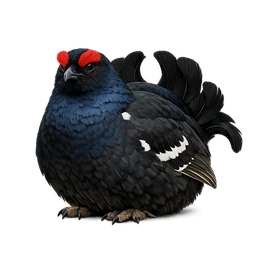
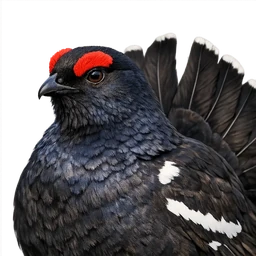
Profile
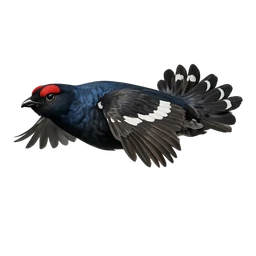
In flight
Game Birds
Black Grouse
Lyrurus tetrix
- rare
- 38 km/h
- Least Concern
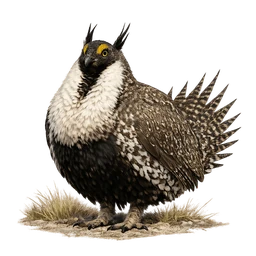
Males gather at dawn leks to bubble, hiss, and fan lyre-shaped tails. Most dramatic entrance in the grouse family.
- Population
- IUCN 2016 global assessment: 8,000,000–14,000,000 mature individuals (population trend: decreasing); total population (all ages) commonly cited as roughly 15–40 million individuals. Regional declines documented in western/central Europe (e.g. UK), with some local recovery from habitat management.
- Habitat
- Moorland, heathland, and steppe-forest transition zones near woodland edges (bogs, pasture, farmland, scattered/nearby trees); shifts to dense coniferous forest in winter
- Fun fact
- The male Black Grouse ("blackcock") performs a communal courtship display called a lek, fanning his lyre-shaped tail and inflating red wattles/neck sacs while making a bubbling, dove-like call to compete for females at a shared display ground — leks can hold under 40 birds in western Europe but 150–200 in Russia.
- Range
- Palearctic: Great Britain and Scandinavia across Russia to Siberia, Mongolia, Kazakhstan, northern China, and Korea
- Diet
- Chicks feed on invertebrates; adults eat buds, shoots, catkins, and berries (bilberry, cranberry, heather) in the growing season, switching almost entirely to conifer needles (pine, larch) in winter
- Size
- 0.5 m
- Wingspan
- 0.72 m
- Lifespan
- 5 years