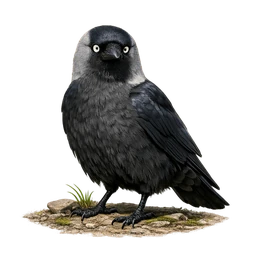
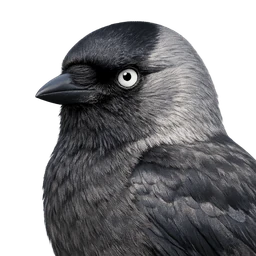
Profile
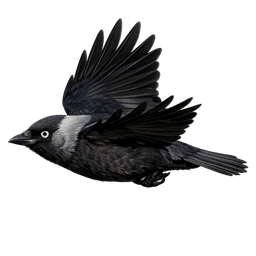
In flight
Clever Corvids
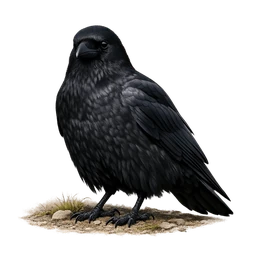
Western Jackdaw
Coloeus monedula
- rare
- 84 km/h
- Least Concern
Small, pale-eyed corvid that mates for life and recognizes individual humans. Delivers and remembers who tipped.
- Population
- Very large and stable/increasing globally; BirdLife-International-sourced estimate of roughly 21-90 million mature/adult individuals worldwide (major populations of 1-10 million breeding pairs each in Turkey and Russia, 1-5 million in Bulgaria, and 5-15 million pairs across the rest of Europe combined); a narrower Europe-only figure of ~15.6-45 million individuals is also cited by some sources (e.g., ~2.5 million in the UK, 1998 estimate).
- Habitat
- Wooded steppe, pasture, cultivated farmland, coastal cliffs, and urban/suburban areas with a mix of large trees, buildings, and open ground for foraging; favors open lowland habitats generally below 500 m elevation, avoiding high mountains and dense forest; nests in cavities — tree holes, cliff crevices, and building/chimney crevices in towns and cities.
- Fun fact
- Western Jackdaws in Britain famously learned to peck open the foil caps on doorstep-delivered milk bottles to drink the cream, a foraging trick that spread culturally between birds (Campylobacter jejuni has even been isolated from their beaks/cloacae as a result of this habit).
- Range
- Europe, western Asia, and Northwest Africa (from the Atlas Mountains through Europe, excluding the subarctic north, eastwards through central Asia to the eastern Himalayas and Lake Baikal); mostly a year-round resident, though northern and eastern populations migrate south in winter; regionally extinct in Malta and Tunisia.
- Diet
- Omnivorous and opportunistic — plant material (grain, seeds, fruit, berries, acorns) makes up roughly 84% of the diet outside the breeding season, when insects become the primary food; also takes invertebrates (beetles, flies, spiders, snails), small rodents, carrion, and occasionally bird eggs/nestlings and human food scraps/refuse.
- Size
- 0.37 m
- Lifespan
- 19 years