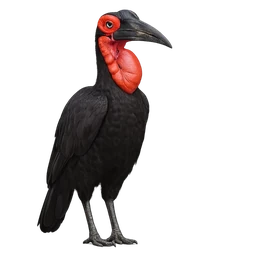
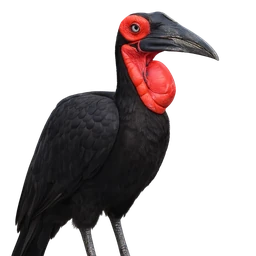
Profile
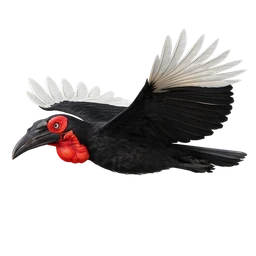
In flight
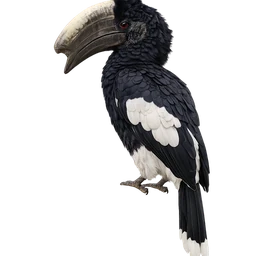
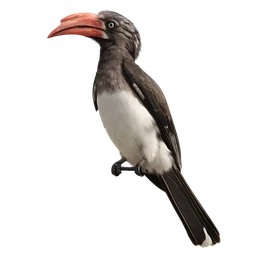
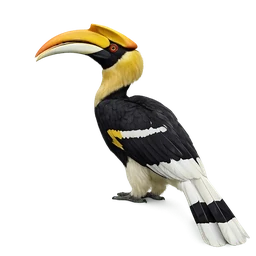
Hornbills
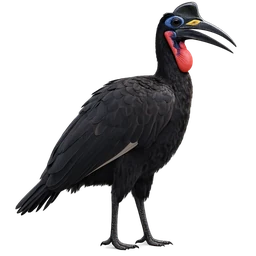
Southern Ground-Hornbill
Bucorvus leadbeateri
- mythic
- 54 km/h
- Vulnerable
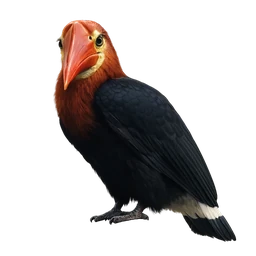
Africa's largest hornbill walks the savanna on foot, booms at dawn, and lives past 70. Bright red face, serious energy.
- Population
- Global total not formally quantified by IUCN/BirdLife (population trend: decreasing); species described as widespread but sparse. Only regional figure available: South Africa subpopulation estimated at ~1,400 mature individuals (1992 survey, ~50% historical decline there); Zambia noted as a relative stronghold with high group densities
- Habitat
- Savanna and woodland (including Mopane woodland and Acacia savanna), and grasslands adjoining forest patches; strongly associated with baobab and riverine trees for nesting/roosting cavities; occurs from sea level up to ~3,000 m elevation
- Fun fact
- Southern Ground-Hornbills are cooperative breeders that typically fledge only one chick every three years (siblicide leaves a single nestling, which then depends on parents/helpers for 1-2 years), one of the slowest reproductive rates of any bird species.
- Range
- Sub-Saharan Africa: from southern Kenya, Rwanda, and Burundi south through DR Congo, Tanzania, Zambia, Mozambique, Zimbabwe, Angola, Namibia, Botswana, Eswatini, and Lesotho to South Africa; non-migratory, year-round resident (Extent of Occurrence ≈ 7,140,000 km², with continuing decline in Area of Occupancy)
- Diet
- Primarily carnivorous: insects and other arthropods, plus snails, frogs, toads, small reptiles, snakes, rodents and other mammals up to hare-sized; occasionally takes carrion and fruit/seeds
- Size
- 1 m
- Wingspan
- 1.5 m
- Lifespan
- 50 years