
Profile

In flight
Waterfowl
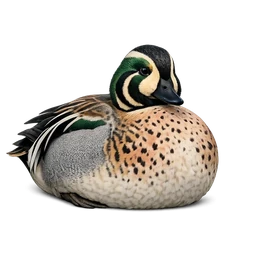
Baikal Teal
Sibirionetta formosa
- rare
- 65 km/h
- Least Concern
One of Asia's most stunning ducks, nearly hunted out. Winters in flocks of half a million. Its Latin name means beautiful.
- Population
- ~500,000–700,000 individuals (333,000–467,000 mature individuals) per current BirdLife/IUCN assessment, trend reported as stable; an older (c.2010) Wikipedia/IUCN figure cites ~1.07 million individuals; both agree the species recovered dramatically from an estimated ~20,000 in the 1980s (South Korea wintering counts alone reached ~1 million+ by 2009)
- Habitat
- Breeds on tundra-edge pools, mossy bogs, and swampy taiga/willow-larch forest in eastern Siberia; winters on freshwater lakes, rivers, reservoirs, farmland, and sheltered coasts, largely in East Asia
- Fun fact
- Baikal Teal numbers in South Korea's wintering grounds alone rebounded from roughly 20,000 birds in the 1980s to about 1 million by 2009, and the species is famous for forming enormous, tightly synchronized wintering flocks whose swirling aerial murmurations are a signature wildlife spectacle of East Asian wetlands.
- Range
- Breeds from the Yenisey basin east to Kamchatka, Russia; migrates through Mongolia and the Korean peninsula; winters mainly in South Korea, Japan, Taiwan, and eastern China (from the Beijing area south toward the Vietnam border, extending west to Yunnan), with historic occurrence recorded as far as South Asia
- Diet
- Largely herbivorous — seeds, aquatic vegetation, grasses and sedges, and waste grain from rice and soybean fields — supplemented with snails and small aquatic invertebrates, taken mostly by surface-feeding (dabbling)
- Size
- 0.41 m
- Wingspan
- 0.7 m
- Lifespan
- 16.5 years