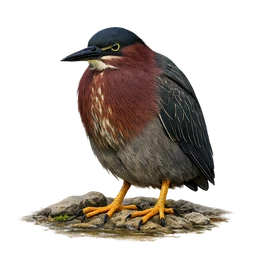
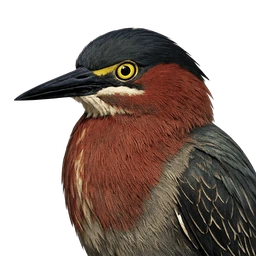
Profile
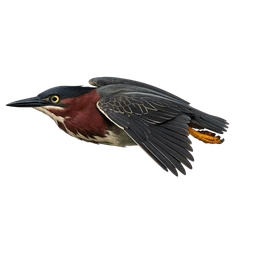
In flight
Cranes & Waders
Green Heron
Butorides virescens
- uncommon
- 40 km/h
- Least Concern
Drops bait on the water to lure fish up. One of the few tool-using birds — your message comes pre-tackled.
- Population
- ~1.2 million (global breeding population, Partners in Flight); declining ~1.3%/year, ~51% cumulative decline 1966-2019 (Cornell Lab / Birds of the World, cites Common Birds in Steep Decline)
- Habitat
- Wetland edges with dense cover — riparian zones, marshes, mangrove-lined shores, ponds, lakes, and slow-moving streams; also human-made canals and ditches. Forages at the water's edge concealed in vegetation rather than in open water.
- Fun fact
- The Green Heron is one of the few bird species known to use tools, dropping bread crusts, insects, or feathers onto the water's surface as bait to lure small fish within striking range.
- Range
- North and Central America. Breeds from southeastern Canada through the eastern and western United States (east and west of the Rockies) south through Mexico and Central America to Panama and the Caribbean; northern populations migrate to winter from the southern US south to northern South America.
- Diet
- Carnivorous ambush predator: primarily small fish (minnows, sunfish, catfish), also frogs, tadpoles, aquatic invertebrates (dragonflies, damselflies, crayfish, waterbugs, leeches, earthworms), and occasionally small rodents, lizards, and snakes.
- Size
- 0.435 m
- Wingspan
- 0.66 m
- Lifespan
- 8 years