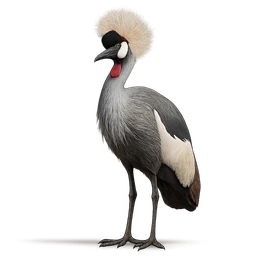
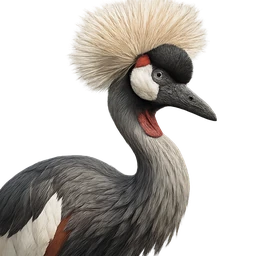
Profile
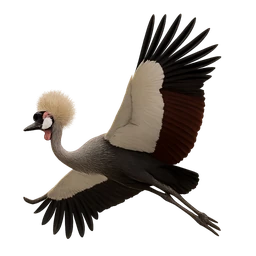
In flight
Cranes & Waders
Grey Crowned Crane
Balearica regulorum
- rare
- 48 km/h
- Endangered
Golden crown, red throat pouch, and killer dance moves. The prom king of birds.
- Population
- ~30,200–36,900 total individuals (20,100–24,600 mature), declining
- Habitat
- Wetlands and adjacent grasslands/savanna in eastern and southern Africa — marshes, pans, dams, and riverbanks with tall emergent vegetation; nests in shallow water (roughly 50–100 cm deep) among vegetation over 1 m tall, but also forages in dry grassland, seasonal wetlands (vleis), and cultivated/pastoral land.
- Fun fact
- The Grey Crowned Crane is one of only two crane species able to roost in trees, thanks to a long hind toe that lets it grip branches — a trait most cranes lack.
- Range
- Eastern and southern Africa in two subspecies: B. r. gibbericeps (~75% of global population) from the eastern Democratic Republic of Congo, Rwanda, Uganda, and Kenya south through Tanzania and Zambia to northern Mozambique, with smaller numbers in Angola, Burundi, Malawi, and South Sudan; B. r. regulorum from southern Mozambique through Zimbabwe to South Africa, with smaller populations in Namibia and Botswana.
- Diet
- Omnivorous: tips of grasses and other plants, seeds, grain (maize, millet, groundnuts, soybeans), insects and other invertebrates, and small vertebrates such as frogs, lizards, small fish, worms, and the eggs of aquatic animals; often follows cattle to catch disturbed insects; known for knocking maize kernels directly off the cob.
- Size
- 1 m
- Wingspan
- 2 m
- Lifespan
- 22 years