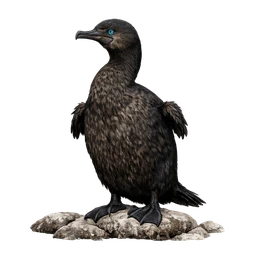
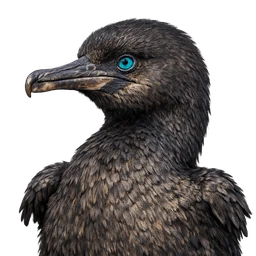
Profile
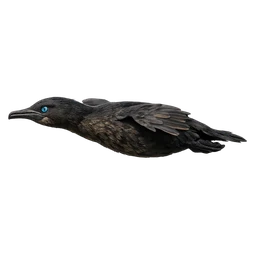
In flight
Seabirds
Flightless Cormorant
Nannopterum harrisi
- epic
- 8 km/h
- Vulnerable
The only cormorant that can't fly. Delivers your message exclusively by swimming.
- Population
- ~2,085 individuals (Galápagos National Park Directorate 2022 census); some older sources (2004–2011 surveys) cite ~1,500–1,679, indicating a recent increasing/stable trend
- Habitat
- Rocky, cool-water volcanic coastlines and near-shore shallow marine waters (bays, straits) within roughly 200 m of shore; birds rest and dry their non-waterproof wings on shoreline rocks after diving
- Fun fact
- Of the world's roughly 40 cormorant species, the Flightless Cormorant is the only one that has lost the ability to fly — its wings are only about a third the size a bird of its body proportions would need to become airborne, and are used instead like flippers for swimming.
- Range
- Endemic to the Galápagos Islands (Ecuador) — restricted to Fernandina Island and the northern/western coasts of Isabela Island, entirely within Galápagos National Park and Marine Reserve
- Diet
- Coastal fish, small octopuses, squid, and eels, caught by diving and hunting along the seabed within about 200 m of shore
- Size
- 0.95 m
- Wingspan
- 0.3 m
- Lifespan
- 13 years