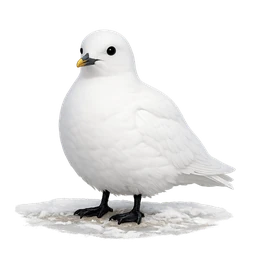
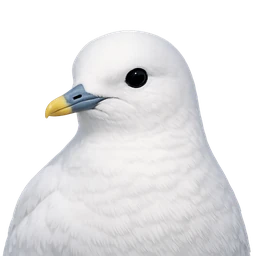
Profile
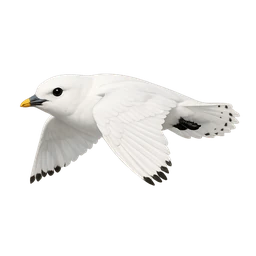
In flight
Seabirds
Ivory Gull
Pagophila eburnea
- mythic
- 130 km/h
- Near Threatened
Pure white, scavenges polar bear kills on the ice pack. Lives where the ice does, for as long as there's ice.
- Population
- 38,000-52,000 mature individuals (2012 estimate), decreasing
- Habitat
- High Arctic sea ice, polynyas, and pack-ice/drift-ice edges; nests on rocky Arctic coastal cliffs, flat gravel islands/spits, beaches, floating ice floes, nunataks, and — more variably than earlier accounts suggest — on high inland mountains over 1,830 m (6,000+ ft) elevation as much as 40 miles (64 km) from the sea; generally restricted to areas north of roughly the July 5C isotherm
- Fun fact
- Ivory Gulls are entirely snow-white year-round and routinely follow polar bears across the pack ice to scavenge seal carcasses left behind after a kill.
- Range
- Circumpolar High Arctic: breeds in the Canadian Arctic Archipelago (Ellesmere, Devon, Cornwallis, Baffin, with the largest known colony on Seymour Island, Nunavut), Svalbard, Greenland, Franz Josef Land, Victoria Island and Severnaya Zemlya (Russia), and other Kara Sea islands; winters along Arctic pack-ice edges/polynyas, notably the Labrador Sea-Davis Strait ice edge and the Bering/Chukchi Seas
- Diet
- Fish, crustaceans, and marine invertebrates; also an opportunistic scavenger that follows polar bears and other predators to feed on seal-kill remains, and consumes carrion, bird eggs and small chicks, seal placentae, and polar bear/seal feces
- Size
- 0.43 m
- Wingspan
- 1.14 m
- Lifespan
- 28 years