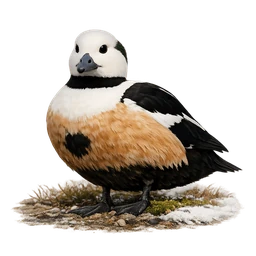
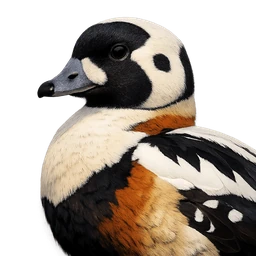
Profile
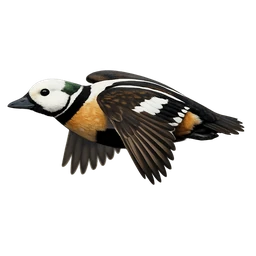
In flight
Waterfowl
Steller's Eider
Polysticta stelleri
- uncommon
- 40 km/h
- Vulnerable
Smallest eider, named for the same naturalist as Steller's Jay. Disappeared from Alaska's North Slope and is barely hanging on.
- Population
- ~110,000–150,000 individuals, decreasing (2016 Wikipedia-cited estimate: 110,000–125,000; BirdLife DataZone assessment: 130,000–150,000)
- Habitat
- Nests on marshy Arctic and sub-Arctic coastal tundra (dominated by water sedge and pendant grass) near lakes and ponds; non-breeding season spent in coastal bays, lagoons, and shallow nearshore marine waters
- Fun fact
- Ringing studies show Steller's Eiders can live over 21 years (21 years, 4 months is the documented ringing-derived longevity record) — a striking figure for a species that undertakes long transcontinental migrations between Russian and Alaskan breeding populations.
- Range
- Breeds along the Russian Arctic coast from the Yamal Peninsula to the Kolyma Delta and on Alaska's Arctic coastal plain (e.g., Utqiagvik); Russian-Atlantic birds winter in the Barents Sea/Novaya Zemlya, northern Norway, and Baltic Sea, while Russian-Pacific and Alaska-breeding birds winter in the Bering Sea, southwest Alaska, Alaska Peninsula, Aleutian Islands, and northern Japan
- Diet
- Crustaceans, mollusks, echinoderms, and polychaete worms taken by diving (to ~9 m) and dabbling in winter; aquatic insect larvae, seeds, and plant matter (e.g., crowberries, pondweeds) on the breeding tundra
- Size
- 0.45 m
- Wingspan
- 0.72 m
- Lifespan
- 21.3 years