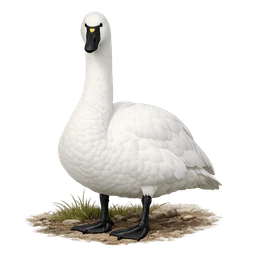
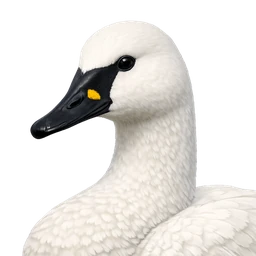
Profile
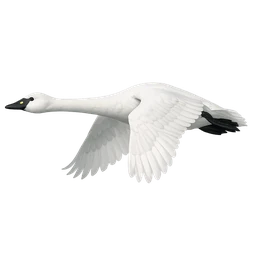
In flight
Waterfowl
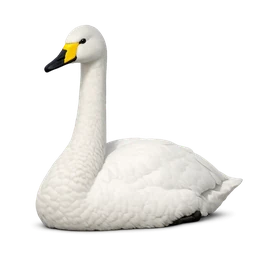
Tundra Swan
Cygnus columbianus
- common
- 56 km/h
- Starter
- Least Concern
Migrates in long ragged lines with a soft bugling call. Delivers messages in cursive across the sky.
- Population
- ~332,000-352,000 individuals globally (roughly 221,000-234,000 mature individuals), per current IUCN Red List / BirdLife DataZone assessment; trend suspected stable overall, though some Eurasian flyway segments are declining while North American populations increase
- Habitat
- Breeds on Arctic and subarctic tundra near shallow pools, lakes, and slow rivers; winters in temperate grasslands, marshes, and shallow coastal/estuarine wetlands, frequently foraging in harvested agricultural fields.
- Fun fact
- The Eurasian subspecies (Bewick's Swan) has a bill pattern of yellow and black markings unique to each individual, letting researchers identify and track single birds across decades of migration studies.
- Range
- Holarctic and fully migratory, comprising two subspecies: the nominate Bewick's Swan breeds across Arctic Russia/Siberia and winters in northwestern Europe and East Asia; the American subspecies (whistling swan) breeds in Arctic Alaska and Canada and winters along the Pacific and Atlantic coasts of North America. Occurs across 60+ countries/territories; 217 Important Bird and Key Biodiversity Areas identified for the species; listed under CMS Appendix II and AEWA.
- Diet
- Herbivorous, supplemented seasonally by mollusks. Breeding-season diet is mainly aquatic vegetation (pondweeds, eelgrass, sedges, roots/tubers); in winter it shifts to grains and waste crops (corn, potatoes, other agricultural leftovers) gleaned from harvested fields, plus aquatic plants in marshes and estuaries. Some wintering populations (e.g. Chesapeake Bay) feed heavily on clams dislodged from mud, per Cornell Lab.
- Size
- 1.32 m
- Wingspan
- 1.9 m
- Lifespan
- 24 years