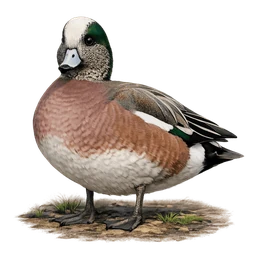
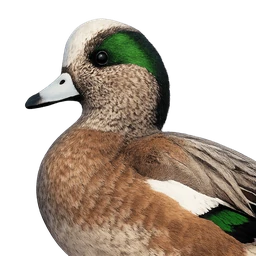
Profile
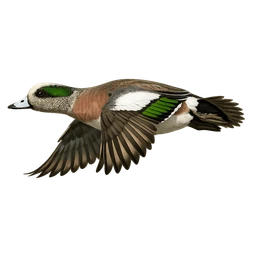
In flight
Waterfowl
American Wigeon
Mareca americana
- uncommon
- 40 km/h
- Least Concern
Whistles instead of quacks. Steals food from coots like it's owed rent.
- Population
- ~2.7 million mature individuals (BirdLife International/Wetlands International estimate, ~2018), consistent with the ~2.5 million breeding birds counted in the widely-cited ~2009 North American waterfowl survey; population is large and slowly declining (~0.3%/yr) per BirdLife DataZone.
- Habitat
- Breeds in freshwater wetlands — marshes, ponds, and lakes with grass/vegetative cover for nesting; winters in coastal and estuarine habitats (estuaries, salt marshes, brackish lagoons) as well as inland lakes, and forages on adjacent grasslands and agricultural fields.
- Fun fact
- Breeding males are nicknamed "baldpate" for their cream-white crown stripe, and American Wigeons are notorious kleptoparasites — snatching submerged vegetation brought to the surface by diving ducks and American Coots rather than diving for it themselves.
- Range
- Breeds across Alaska, Canada, and the interior western United States (breeding extent of occurrence ~17.4 million km² per BirdLife); winters in the southern US, Mexico, Central America, the Caribbean, and northwestern South America (non-breeding extent ~38.6 million km²); a rare but regular vagrant to western Europe.
- Diet
- Primarily herbivorous dabbling duck — grazes on grasses, clover, waste grain, and winter wheat in fields; dabbles for aquatic plants and algae in wetlands; also kleptoparasitizes vegetation brought to the surface by diving ducks and American Coots.
- Size
- 0.5 m
- Wingspan
- 0.84 m
- Lifespan
- 21 years